

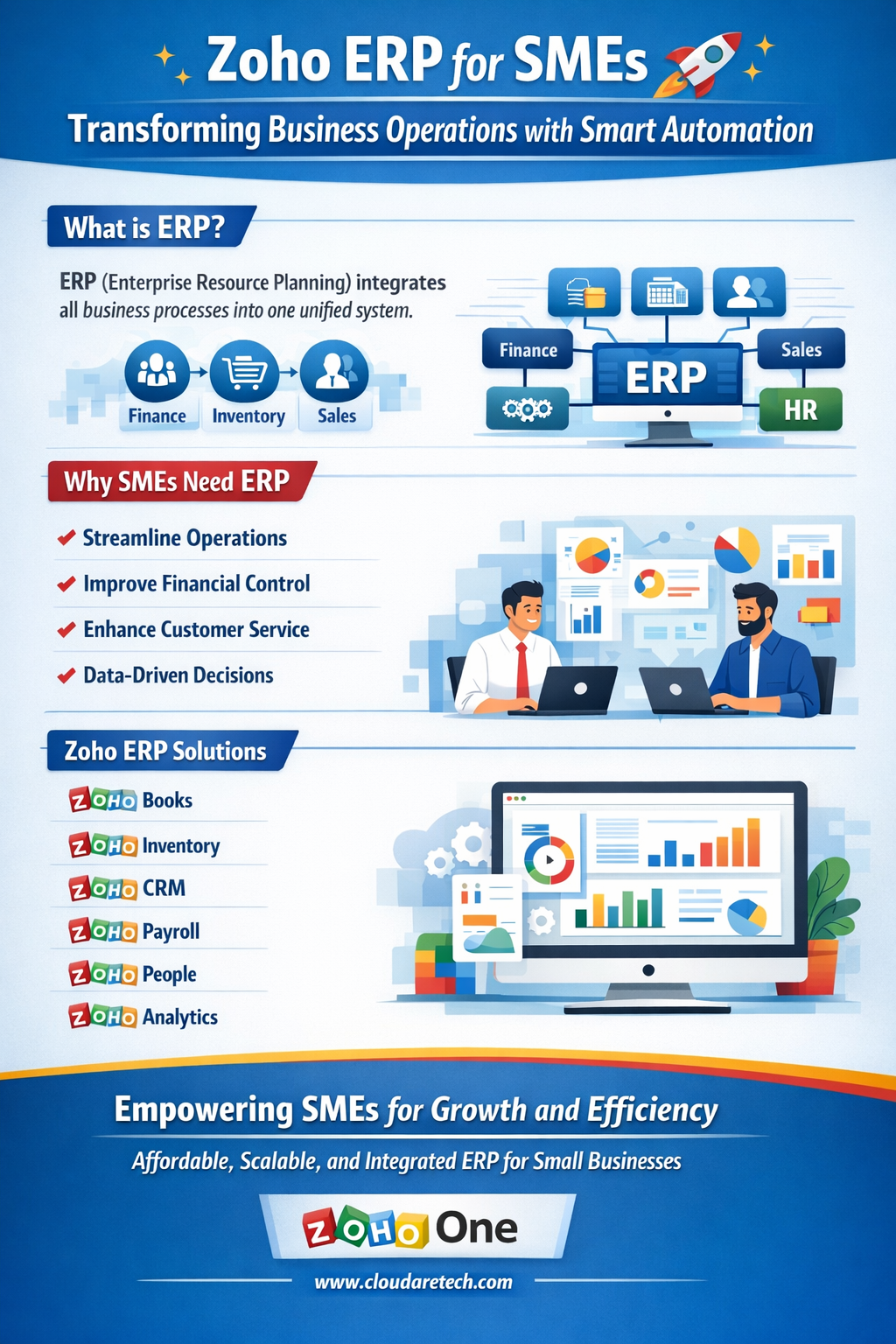
What is ERP?
Enterprise Resource Planning (ERP) is a business management software that integrates various core functions of an organization into a single unified system. Instead of using separate tools for accounting, sales, inventory, HR, and customer management, an ERP platform connects all these processes in one centralized environment.
ERP systems help organizations collect, store, manage, and analyze data from different departments in real time. This creates a seamless flow of information across the business, enabling teams to collaborate efficiently and make data-driven decisions.
Key business functions typically managed through ERP include:
- Finance and Accounting
- Inventory and Supply Chain Management
- Sales and Customer Relationship Management (CRM)
- Procurement and Vendor Management
- Human Resources and Payroll
- Reporting and Business Analytics
By integrating all operations into one platform, ERP eliminates data silos and improves operational visibility across the organization.
Why Do Businesses Need an ERP?
As businesses grow, managing operations through spreadsheets, standalone software, or manual processes becomes inefficient and prone to errors. This is where ERP systems become essential.
An ERP provides a centralized source of truth for business data, allowing companies to streamline operations, automate workflows, and gain better control over their processes.
Some key benefits of implementing an ERP include:
1. Improved Operational Efficiency
ERP automates repetitive tasks and standardizes processes, reducing manual effort and operational delays.
2. Real-Time Data Visibility
Management gets access to real-time insights across departments, helping them make faster and more informed decisions.
3. Better Collaboration Across Teams
With all departments working on the same platform, communication improves and teams can collaborate more effectively.
4. Reduced Errors and Data Duplication
Since all data resides in one system, the chances of duplicate entries and manual errors are significantly reduced.
5. Scalable Business Growth
ERP systems allow businesses to scale operations without increasing complexity in management.
Why SMEs Need ERP More Than Ever
Small and Medium Enterprises (SMEs) often operate with limited resources while trying to compete with larger organizations. Many SMEs initially rely on spreadsheets, disconnected applications, or manual systems to manage their operations. However, as the business expands, these systems quickly become difficult to manage.
For SMEs, ERP acts as a powerful tool to streamline operations, reduce inefficiencies, and build a strong foundation for growth.
Here’s why ERP is particularly important for SMEs:
1. Process Standardization
ERP helps SMEs standardize their business processes, ensuring consistency in operations such as sales, procurement, and accounting.
2. Cost Control and Financial Visibility
An ERP provides accurate financial data, helping businesses monitor cash flow, control expenses, and improve profitability.
3. Better Inventory and Supply Chain Management
SMEs can track inventory levels, manage orders efficiently, and reduce stock shortages or overstocking.
4. Enhanced Customer Experience
With better order management, faster response times, and integrated CRM capabilities, SMEs can provide improved service to their customers.
5. Data-Driven Decision Making
ERP provides analytical reports and dashboards that help SME leaders make strategic decisions based on accurate business data.
In today’s competitive business environment, SMEs that adopt ERP systems gain a strong operational advantage over those relying on manual processes.
How Zoho ERP Plays a Crucial Role for SMEs
Zoho has emerged as one of the most powerful and cost-effective ERP ecosystems for small and medium-sized businesses. Instead of a single monolithic ERP system, Zoho offers a suite of tightly integrated applications that together function as a complete ERP solution.
The Zoho ecosystem includes applications such as:
- Zoho Books – Accounting and financial management
- Zoho Inventory – Inventory and order management
- Zoho CRM – Sales and customer relationship management
- Zoho Payroll – Employee payroll processing
- Zoho People – HR management
- Zoho Analytics – Business intelligence and reporting
- Zoho Creator – Custom application development
These applications seamlessly integrate with each other under the Zoho One platform, allowing businesses to manage their entire operations within a unified ecosystem.
Key Advantages of Zoho ERP for SMEs
1. Affordable and Scalable
Zoho provides enterprise-grade capabilities at a cost that is accessible for SMEs, making digital transformation achievable even for growing businesses.
2. Cloud-Based Flexibility
Being a cloud-based platform, Zoho allows businesses to access their systems from anywhere, enabling remote work and real-time collaboration.
3. Highly Customizable
Zoho offers strong customization capabilities through tools like Zoho Creator and Zoho Flow, enabling businesses to tailor workflows according to their operational needs.
4. Seamless Integration Across Applications
Zoho applications are built to work together, ensuring smooth data flow across departments without the need for complex integrations.
5. Automation and Intelligence
Businesses can automate approvals, notifications, invoicing, reporting, and many other operational workflows, improving productivity and reducing manual intervention.
The Future of SME Digital Transformation with Zoho
As businesses increasingly move toward digital operations, ERP systems are no longer optional—they are essential. For SMEs looking to improve efficiency, gain better operational control, and scale their business effectively, Zoho ERP provides a powerful and flexible solution.
With its integrated ecosystem, cloud-first architecture, and SME-friendly pricing, Zoho enables businesses to adopt enterprise-level capabilities without the complexity traditionally associated with ERP systems.
By implementing Zoho ERP, SMEs can not only streamline their current operations but also build a technology-driven foundation for long-term growth and innovation.




Leave a Reply
You must be logged in to post a comment.