

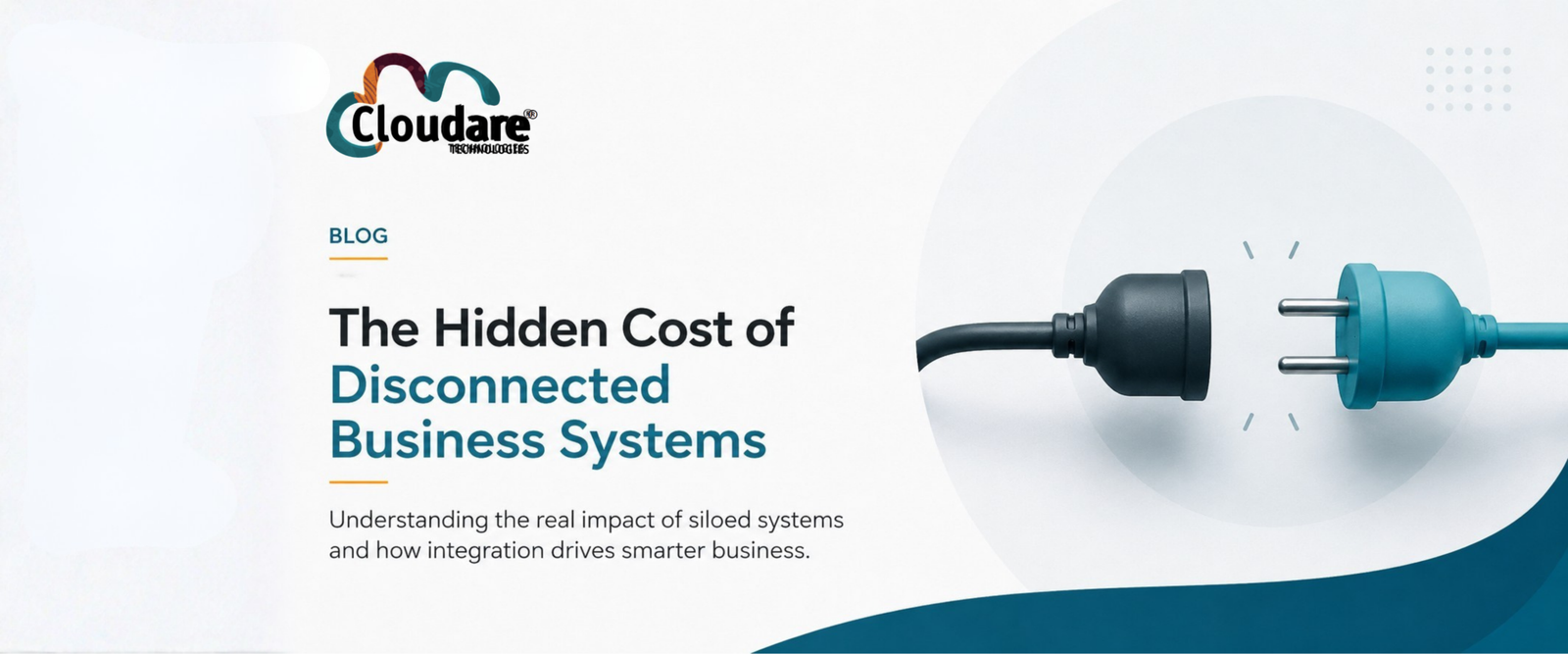
Modern businesses rely on multiple systems to manage finance, sales, inventory, HR, customer relationships, and operations. But when these systems operate independently, the technology designed to improve efficiency can become a source of complexity.
The real cost of disconnected systems isn’t always visible on the balance sheet. It appears in duplicated data, manual work, delayed decisions, operational errors, and lost productivity.
What Are Disconnected Business Systems?
Disconnected systems are applications that don’t communicate effectively with each other.
For example, a business may use:
- An ERP for finance and operations
- A CRM for sales and customer management
- Separate inventory or warehouse software
- Payroll and HR applications
- E-commerce platforms
- E-invoicing and tax-compliance solutions
When these systems aren’t properly integrated, employees often have to move information manually from one platform to another.
That’s where the problems begin.
1. Duplicate Data Entry
When systems don’t share data automatically, the same information may need to be entered multiple times.
A sales order might need to be entered into the CRM, ERP, inventory system, and invoicing platform.
This doesn’t just consume time. Every additional manual entry creates another opportunity for human error.
2. Inconsistent Information
Disconnected systems can create multiple versions of the same data.
For example, the sales team may have one customer record while finance has another. Inventory information in one system may not match what is available in another.
Without a connected data flow, answering a simple question such as “What is our current stock position?” can require checking multiple systems.
3. Delayed Business Decisions
Business decisions depend on accurate and timely information.
When data has to be collected manually from different applications, reporting becomes slower.
By the time management receives a consolidated report, the underlying information may already have changed.
Connected systems enable businesses to move from delayed reporting to more timely, data-driven decision-making.
4. Higher Operational Costs
Disconnected technology creates hidden operational costs.
Employees spend time:
- Downloading and uploading files
- Copying data between systems
- Reconciling records
- Correcting errors
- Creating manual reports
- Following up across departments
Individually, these tasks may seem small. Across an organization, they can represent hundreds of hours of productivity every year.
5. Poor Customer Experience
Customers don’t see your internal systems—but they experience their impact.
A disconnected environment can contribute to:
- Delayed order updates
- Incorrect invoices
- Slow responses
- Inventory availability issues
- Repeated requests for customer information
When customer-facing teams have access to accurate information, they can respond faster and provide a more consistent experience.
6. Limited Scalability
Disconnected systems may work when a business is small.
As transaction volumes, employees, locations, and applications increase, manual processes become increasingly difficult to manage.
Adding another system without considering integration can create another data silo.
Growth should not mean adding more disconnected processes.
How Integration Changes the Picture
Business system integration creates a connected technology ecosystem where applications can exchange information automatically.
APIs, middleware, integration platforms, and workflow automation can connect systems such as:
ERP ↔ CRM ↔ E-Commerce ↔ Inventory ↔ Finance ↔ E-Invoicing
Instead of employees constantly moving information between applications, systems can exchange data based on defined business processes.
This can help businesses achieve:
- Reduced manual work
- Better data consistency
- Faster information flow
- Improved operational visibility
- Fewer processing errors
- More scalable workflows
Integration Is More Than Connecting Software
Successful integration isn’t simply about making two systems communicate.
The technology needs to support the business process behind the integration.
Before implementing an integration, businesses should consider:
What data needs to move?
Identify the information exchanged between systems.
When should it move?
Define whether data should move in real time, on a schedule, or based on specific events.
Where should it go?
Map each data field and destination accurately.
What happens when something fails?
Build validation, error handling, logging, and monitoring into the integration.
How will the integration scale?
The architecture should support future applications, higher transaction volumes, and changing business requirements.
The Goal: A Connected Digital Ecosystem
Businesses don’t necessarily need more software.
They need their existing technology to work together effectively.
A well-integrated ecosystem allows information to flow across departments and applications while reducing unnecessary manual intervention.
The objective isn’t simply automation for the sake of automation.
It’s creating a smarter flow of information across the business.
Final Thoughts
Disconnected business systems can quietly reduce productivity, increase operational costs, create data inconsistencies, and slow down decision-making.
As businesses adopt more digital tools, integration becomes increasingly important.
The question is no longer:
“Do we have the right software?”
It is:
“Can our systems work together?”
A connected technology environment can help businesses simplify operations today while creating a stronger foundation for future growth.
Build a Connected Business with Cloudare
At Cloudare Technologies, we help businesses connect ERP platforms, applications, workflows, and compliance solutions through ERP implementation, system integration, customization, and automation.
From integrating existing applications to designing scalable business workflows, our focus is on making technology work together around your business processes.
Ready to connect your business systems?
📩 Email: hello@cloudare.in
🌐 Website: cloudare.in
Let’s build a more connected and scalable business together.



Leave a Reply
You must be logged in to post a comment.