


Introduction: What Is ERP Implementation?
ERP (Enterprise Resource Planning) implementation is the structured process of deploying an ERP system to integrate and manage an organization’s core business functions – such as finance, sales, inventory, procurement, HR, and operations – within a single unified platform.
Instead of working with disconnected tools, spreadsheets, or legacy software, ERP implementation enables businesses to operate on one source of truth, ensuring real-time visibility, better control, and scalable growth. However, ERP is not just about installing software – it’s about aligning technology with business processes.
Why Do Businesses Need ERP Implementation?
As organizations grow, complexity increases. Manual processes and siloed systems begin to create inefficiencies, errors, and decision delays. ERP implementation helps businesses overcome these limitations by:
- Centralizing data across departments
- Automating repetitive processes
- Improving financial accuracy and compliance
- Enhancing operational visibility
- Supporting scalable growth and expansion
For businesses transitioning from Excel, Tally, Marg, or fragmented tools, ERP implementation becomes a strategic necessity, not an option.
Common Challenges in ERP Implementation
Despite its benefits, ERP implementation comes with challenges – especially if not handled correctly.
1. Poor Requirement Understanding
Lack of clarity in business processes often leads to incorrect system configuration.
2. Resistance to Change
Employees may struggle to adapt to new workflows and technology.
3. Data Migration Issues
Inaccurate or incomplete data migration can disrupt operations.
4. Over-Customization
Excessive customization can increase costs, timelines, and system complexity.
5. Budget & Timeline Overruns
Without proper planning, ERP projects may exceed expected cost and duration.
These challenges highlight why ERP implementation is not a DIY exercise.
How the Right ERP Partner Helps Overcome These Challenges
A reliable ERP implementation partner plays a critical role in ensuring project success by:
- Conducting detailed requirement and process mapping
- Recommending the right ERP solution based on business size and industry
- Following structured implementation methodologies
- Ensuring clean data migration and system integration
- Providing user training and post go-live support
- Balancing standardization and customization
An experienced partner ensures that ERP becomes a business enabler, not a bottleneck.Choosing the Right ERP Platform
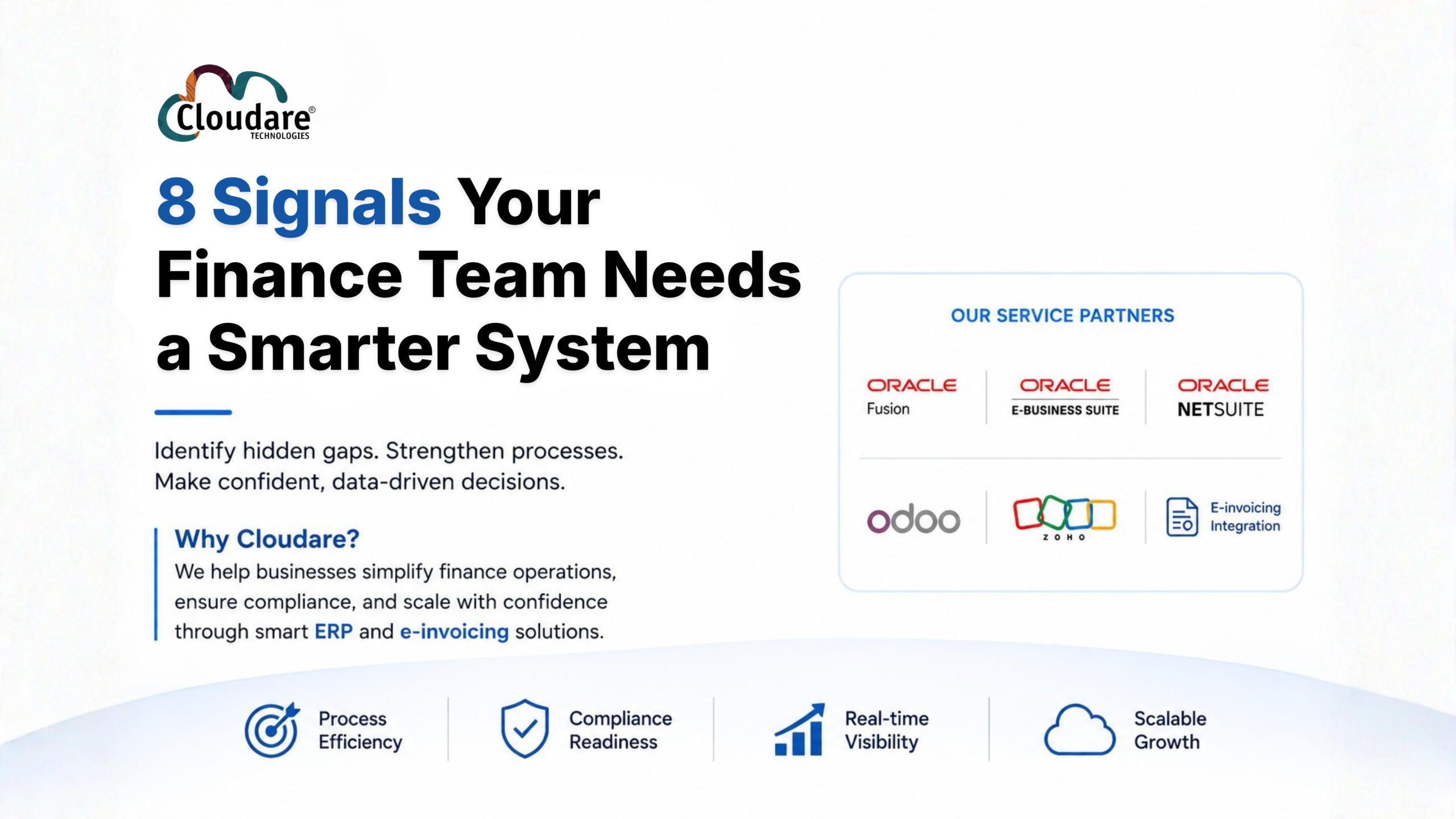
Depending on business needs, different ERP platforms serve different segments:
- Oracle – Ideal for mid-to-large enterprises with complex, compliance-driven operations
- Zoho – Best suited for SMEs and fast-growing businesses looking for cloud-first automation
- Odoo – Perfect for businesses needing flexibility and deep customization
Selecting the right platform – and implementing it correctly – is where expert guidance matters.
Why Choose Cloudare Technologies for ERP Implementation?
Cloudare Technologies is an official implementation partner of Oracle, Zoho, and Odoo, helping businesses streamline operations and scale with confidence.
What Sets Us Apart:
- ✅ 40+ Certified ERP Experts
- ✅ Trusted by 100+ Clients across industries
- ✅ Proven experience in ERP implementation, customization, and support
- ✅ Process-driven approach with clear timelines
- ✅ Strong focus on post go-live success
- ✅ Free Go Live support for 1 Month
We don’t just implement ERP – we align technology with your business goals.
Call to Action
Planning an ERP implementation or struggling with an existing system?
Let our experts help you choose, implement, and optimize the right ERP solution.
📧 Email: sales@cloudare.in
🌐 Website: www.cloudare.in
Connect with Cloudare Technologies today and turn your ERP investment into a growth engine. 🚀




Leave a Reply
You must be logged in to post a comment.